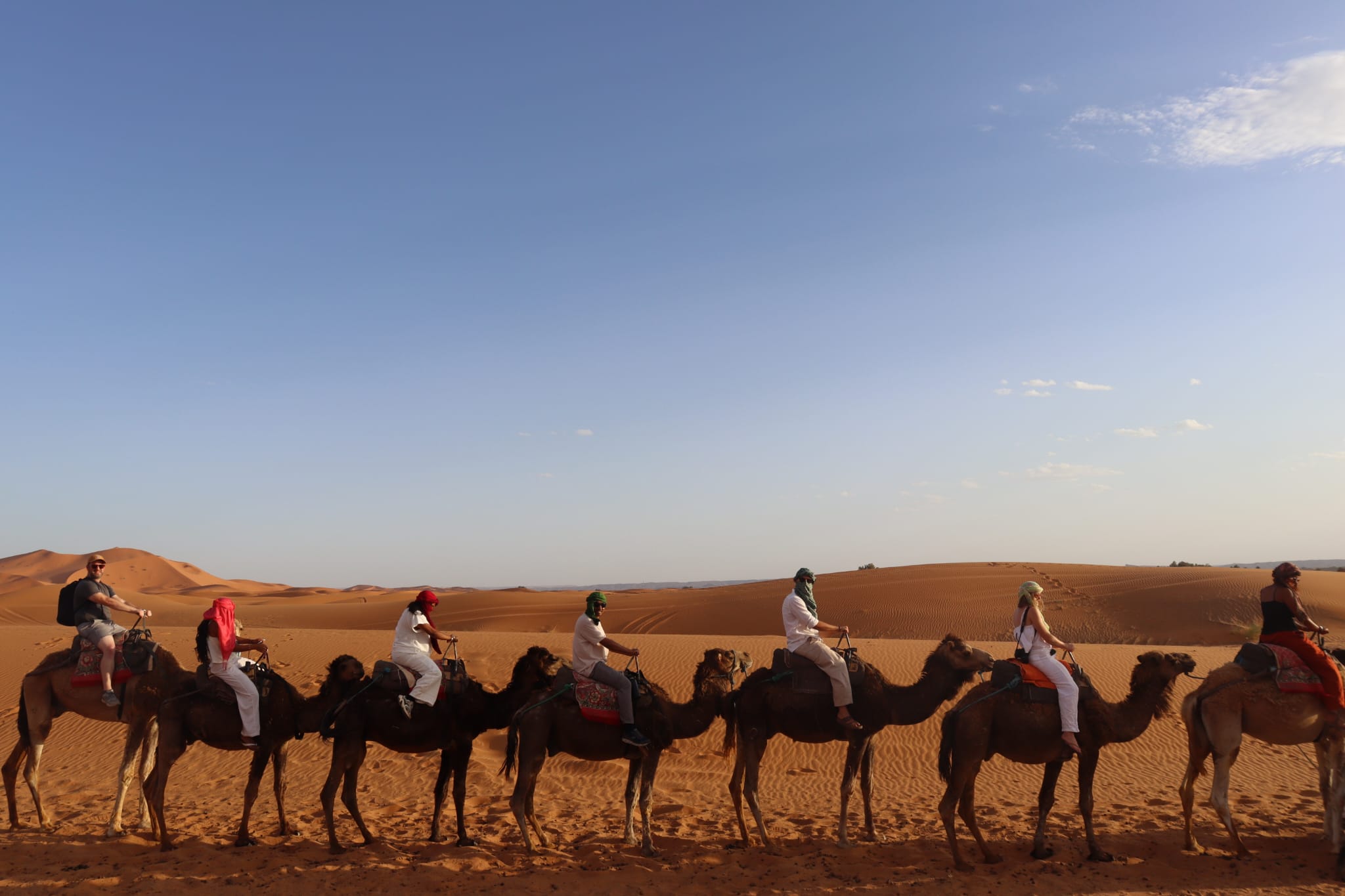
The music was loud, the windows were down and the highway had disappeared behind them. 
Packed into an old Land Cruiser, University of Georgia students bounced over the rolling dunes of the Sahara Desert as their driver accelerated toward a camp hidden among the sand. Afrobeats played through the speakers. Each rise brought another drop, sending their heads toward the ceiling and laughter through the vehicle.
For Leehee Brauner and Maithili Kumar, it was a moment almost too extraordinary to process.
“We’re in the Sahara Desert right now, in the dunes,” Kumar remembered thinking. “What is going on?”
Brauner called it simply a “peak memory”, one unlike anything she had experienced before.
Hours later, the energy of that ride gave way to stillness. After dinner and a musical performance by members of the local Berber community, students climbed to the top of a dune. They stretched out on the cool sand, talked about everything from their favorite colors to their lives back home and stared into a sky unobstructed by city lights.
“It was unreal, honestly,” Kumar said.
The night offered the kind of memory people hope to find on a study abroad program.

SPIA’s Morocco study abroad program immerses students in the politics, cultures, histories and development challenges shaping one of North Africa’s most dynamic countries. Over three weeks, students travel across Morocco, meeting with scholars, nonprofit leaders and community members while exploring topics ranging from migration and environmental policy to religion, education and international affairs. Throughout the trip, they examine Morocco as a case study for understanding broader political and social dynamics across the Middle East and North Africa.
The program is led by Eli Sperling, the Israeli Institute Teaching Fellow in the Department of International Affairs, whose teaching and research focus on the politics and history of the Middle East. Sperling has traveled and conducted research extensively throughout the region and has spent significant time in Israel and, Egypt, including Cairo and the Sinai Peninsula.
Morocco became a natural extension of those interests. While researching Morocco’s relationship with Israel, Sperling was also introduced to the country through UGA’s Connect Abroad program, where he served as a faculty leader on an earlier Morocco trip. Struck by the country’s diversity, complexity and educational potential, he saw an opportunity to create a program that would help students engage directly with the politics, cultures and social dynamics of North Africa and the broader Middle East
“It offers a really unique launch pad into understanding the politics and social dynamics of the region,” Sperling said.
The program began in Rabat, Morocco’s capital, where students attended lectures, met with local scholars and organizations, visited cultural institutions and encountered the country’s political life firsthand.
Kumar, a senior international affairs and religion student whose interests include human rights and global development, remembers arriving tired after a long flight, only to be drawn immediately to the landscape beyond the bus window.
Purple flowering trees lined the drive into the city. Roads were clear and orderly. As the group passed the Moroccan parliament, students saw protesters gathered outside.
Brauner, a sophomore international affairs and Arabic student who is interested in Middle Eastern politics, was struck by how different Morocco was from the place she had imagined. Even the language challenged her expectations; Moroccan Arabic sounded unfamiliar despite her previous study.
 Rabat appeared highly modern, she said, while the changing architecture and communities outside the city revealed significant differences in development across the country.
“It was totally different than any place I’d ever been,” Brauner said.
That complexity followed the group throughout its travels. In Tangier, only a few miles from Spain across the Strait of Gibraltar, students met with leaders of an organization working on migration and human rights. In Fez, they explored the city’s historic Jewish quarter and learned traditional pottery techniques. They walked through the Atlas Mountains, visited an Berber community near the Sahara, attended lectures on women’s and environmental issues in Marrakesh and concluded the trip in Casablanca, Morocco’s largest city and economic center.
No two days looked quite the same. Lectures and organizational visits were paired with walking tours and cultural activities, transforming cities, markets, universities, and bus rides into extensions of the classroom.
Sperling designed the program around the idea that students learn differently when they can experience a place for themselves.
“Students can learn about monarchies, democratic institutions, censorship, migration and foreign policy in Athens,” he said. “In Morocco, they can ask local scholars and residents what those systems look like in their daily lives—what their vote means to them, how they see their country and what they think about the United States and its role in the region.”
Those first-person experiences and conversations informed the independent research projects each student completed after returning home.
Brauner examined how Morocco uses its location along the migration corridor between Africa and Europe as a tool of statecraft. Her project grew from the group’s visit with the migration and human rights organization in Tangier and compared Morocco’s relationships with Spain and Senegal.
Kumar explored the relationship among religion, education and political legitimacy, studying how the Moroccan monarchy uses Islamic education and religious institutions as forms of soft power. The question became more focused as she visited mosques and madrasas, heard from policy experts, and talked with Sperling during hikes and long drives.
“I think I told Dr. Sperling my entire life story on one hike,” Kumar joked. “That’s where we really narrowed down my topic.”
Across the class, students investigated subjects ranging from sustainability diplomacy and public health to media censorship, tea culture and Morocco’s foreign relations. Sperling held what he called “bus ride office hours” during the group’s longest drives, meeting individually with students to help them transform their observations into focused research questions.
The settings may have been unconventional—some questions were even workshopped during a poolside lecture—but the academic expectations were real.
For Brauner and Kumar, the opportunity to participate was made possible by the scholarship support of the Wildman Scholars of the Middle East Fund, administered through the Benson-Bertsch Center for International Trade and Security.
“I could not have gone on this program without the scholarship,” Brauner said. “Someone gave me the scholarship, and they invested in me. I was going to come here and get everything that I could because this is not an opportunity that you get every single day.”
The support allowed her to enter the program clearheaded and focused on learning rather than on the financial burden of participating.
Kumar expressed a similar sense of gratitude. With the trip’s expenses covered, she said, she could be fully present—able to experience the country, pursue new questions and “get the most out of it without worrying about the financial areas.”
That investment carried students from conversations with scholars and human rights advocates to the maze-like medinas of Morocco’s imperial cities. It placed them under the Milky Way in the Sahara and at dinner tables filled with couscous, caramelized onions and raisins. It gave them room to imagine new research interests and possible careers.
But some of the most memorable moments had nothing to do with research papers, guest lectures, or future career plans.
Brauner and Kumar, who were in different years and might not otherwise have met, became friends while hiking a mountain in Morocco. Other students held heart-to-heart conversations during two-hour camel rides. They shared long days on buses, meals in unfamiliar cities and the collective exhaustion and excitement of constantly encountering something new.
 “We had an awesome group,” Brauner said. “We made such good friendships.”
Sperling believes those connections are part of what makes study abroad so powerful. His own undergraduate experiences in the Middle East helped shape his academic career, and he now watches students discover questions and interests that may influence their own futures.
“The lessons do not end when they return to Athens,” he said. “Students carry home a deeper curiosity about the world, greater confidence asking questions and relationships that can last a lifetime.” For Kumar, the advice to other students is straightforward: Apply. “Just do it,” she said. “It ended up being one of the most important trips of my life.”
Written by: Caroline Paczkowski
Pictures provided by: Leehee Brauner